Let’s be honest, remember when the pinnacle of in-car tech was a six-disc CD changer and maybe, if you were really pushing the boat out, satellite navigation that sounded like a disgruntled robot? Those days are ancient history. The car parked in your drive is rapidly transforming from a simple machine that gets you from A to B into a hyper-connected, intelligent companion on wheels. It’s no longer just about horsepower and handling; it’s about processing power and data streams.
The automotive world is in the middle of its most dramatic shake-up ever. We’re talking about a revolution fuelled by code, sensors, and some seriously clever thinking. These aren’t just minor tweaks; these are fundamental shifts that redefine what a car is and what it can do for you. So, buckle up. We’re about to take a spin through the top 10 emerging automotive technologies that are steering us into a wild, wonderful, and wildly different future.
1. Autonomous Driving: The Chauffeur in the Cloud
This is the big one, the tech that promises to turn every driver into a passenger. We’re not quite at the stage of napping during the morning commute just yet, but we’re getting tantalisingly close. Autonomous driving is all about creating cars that can sense their environment and navigate without human input.
It’s all broken down into “levels,” which sound a bit like a video game, and in a way, they are.
| Level of Autonomy | What It Means for You | Example |
| Level 0-2 | You’re still very much in charge, but the car helps with things like staying in your lane or adaptive cruise control. Think of it as a helpful co-pilot. | Tesla’s Autopilot, Cadillac’s Super Cruise |
| Level 3 | The car can handle most driving situations, but you need to be ready to take back the wheel at a moment’s notice. The “eyes on the road, but mind can wander” stage. | Mercedes-Benz DRIVE PILOT |
| Level 4 | This car can fully drive itself in specific areas or conditions (like a city centre or on the motorway). You can genuinely check your emails. | Waymo’s Robotaxi Service |
| Level 5 | The holy grail. No steering wheel, no pedals. The car handles everything, everywhere. Just tell it where to go. | Still conceptual, the ultimate goal. |
The dream? A world with fewer accidents, less traffic, and more free time. The reality? A complex web of technology, regulation, and public trust that we’re still untangling.
2. Electrification & Next-Gen Batteries
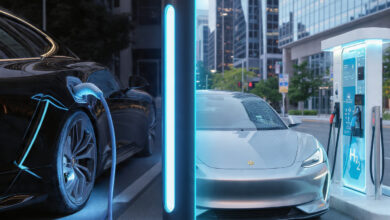
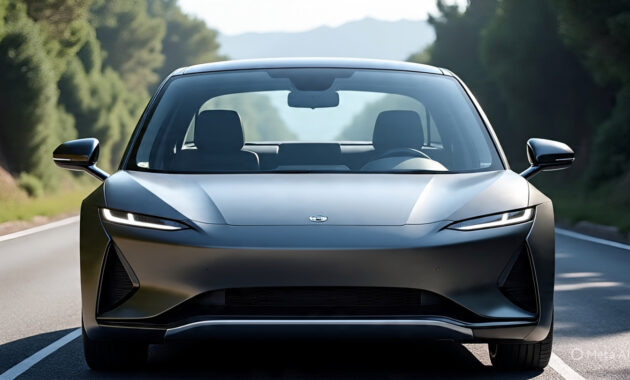
Electric vehicles (EVs) are hardly “emerging” anymore they’re here, and they’re spectacular. But the real game-changer is what’s happening inside the battery pack. The race is on to create batteries that are cheaper, charge faster, and hold more energy. I’m talking about solid-state batteries that could offer over 500 miles of range and recharge in the time it takes to grab a coffee.
This isn’t just about swapping petrol pumps for charging plugs. It’s a complete rethink of vehicle design. Without a bulky engine and transmission, designers have the freedom to create more spacious interiors and wilder exterior shapes. The electric revolution is making cars quiet, ridiculously quick, and, dare I say it, cool again.
3. V2X Communication: The Social Network for Cars
What if your car could talk to other cars? And not just that, but to traffic lights, pedestrian crossings, and the road itself? That’s the promise of Vehicle-to-Everything (V2X) communication. Think about it:
- Vehicle-to-Vehicle (V2V): Your car gets a warning from the car ahead that it’s braking hard, long before you can see it.
- Vehicle-to-Infrastructure (V2I): A traffic light tells your car it’s about to turn red, helping you time your speed for a smoother journey.
- Vehicle-to-Pedestrian (V2P): Your car detects a cyclist’s smartphone signal around a blind corner.
V2X is the invisible safety net that will make our roads dramatically safer. It’s one of the most critical future car technology trends because it allows cars to see the unseen, creating a collective awareness that a human driver could never achieve alone.
4. Augmented Reality Heads-Up Displays (AR HUDs)
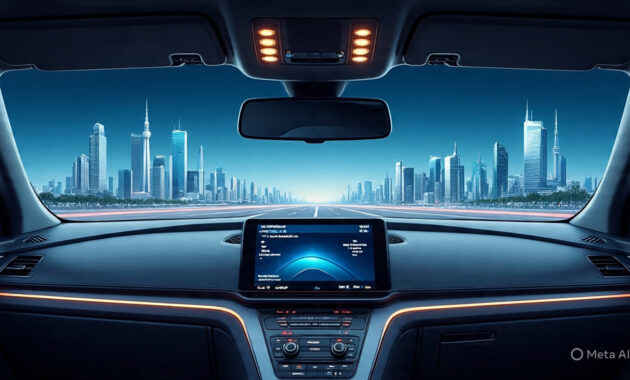
Forget looking down at a screen for directions. Augmented Reality (AR) is bringing that information directly into your line of sight. AR HUDs project a transparent display onto the windscreen, overlaying digital information onto the real world.
Imagine seeing a floating arrow telling you exactly which turn to take, or having a potential hazard, like a pedestrian, highlighted with a glowing box. It feels like something out of Iron Man, making driving more intuitive and safer by keeping your eyes where they should be: on the road. It’s turning your entire windscreen into a smart, interactive surface.
5. Artificial Intelligence (AI): The Brains of the Operation
If you think of all these technologies as the car’s body, AI is the brain. It’s the silent force powering almost every modern innovation. AI isn’t just about self-driving; it’s everywhere.
- Predictive Maintenance: The car’s AI analyses data from thousands of sensors to tell you a part might fail before it actually does. No more surprise breakdowns.
- Personalisation: It learns your preferences your favorite temperature, your go-to playlist, the seat position you prefer and sets everything up for you automatically.
- Driver Monitoring: AI-powered cameras can detect if you’re getting drowsy or distracted and suggest you take a break.
As a deep dive by Startus Insights reveals, countless startups are finding new ways to integrate AI, making the car less of a tool and more of a proactive assistant.
6. 3D Printing on the Production Line
3D printing, or additive manufacturing, is revolutionising how cars are made. Initially used for creating prototypes, it’s now being used to produce actual parts for production vehicles. Why does this matter? Because it allows manufacturers to create complex, lightweight parts that would be impossible with traditional methods.
This means stronger, lighter, and more efficient cars. It also opens the door to incredible customisation. Imagine being able to order bespoke interior trim or custom-designed alloy wheels, printed just for you. In the future, a local garage might just “print” you a new spare part instead of ordering one from a warehouse.
7. Next-Level Automotive Cybersecurity
Let’s be blunt: a modern car is a computer on wheels, and anything with a computer can be hacked. As cars become more connected through V2X and onboard internet, they also become more vulnerable.
This has given rise to a whole new field: automotive cybersecurity. It’s a silent, invisible battle being waged by engineers to protect your car’s critical systems from the brakes and steering to your personal data from malicious attacks. Think of it as a digital fortress, constantly guarding against unseen threats. It might not be the sexiest tech, but it’s arguably one of the most important.
8. In-Car Wellness and Biometrics
The next frontier for luxury is your well-being. Cars are starting to become mobile wellness spaces, using biometric sensors to monitor your health and mood.
We’re seeing systems that can:
- Track your heart rate and breathing through sensors in the seat or steering wheel.
- Detect signs of stress and respond by playing calming music, changing the ambient lighting, or even releasing soothing scents.
- Purify the air in the cabin, filtering out pollutants and allergens.
Your car won’t just get you to your destination; it will ensure you arrive feeling refreshed and relaxed. It’s the ultimate blend of mobility and mindfulness.
9. Advanced Lightweight Materials
The push for efficiency, whether in EVs or traditional cars, is all about shedding weight. This is where advanced materials come in. We’re moving beyond steel and into a new era of materials science. Carbon fibre, once reserved for supercars, is becoming more common. Car makers are also using advanced aluminium alloys and even self-healing polymers that can repair minor scratches on their own.
Lighter cars handle better, accelerate faster, and use less energy. It’s a simple equation, but achieving it requires some incredibly complex and innovative engineering, as highlighted by leaders in automotive R&D.
10. Blockchain for Trust and Transparency
Blockchain isn’t just for cryptocurrencies. In the automotive world, its power lies in creating a secure, unchangeable digital ledger. What could you use that for?
Well, for starters, you could create a “digital passport” for a vehicle. Every MOT, service, and repair could be logged on the blockchain. When you buy a used car, you could see its entire, verified history, eliminating the guesswork and a lot of the risk. It can also be used to secure automated payments for things like tolls, parking, and EV charging, or to track parts through the supply chain to ensure they’re genuine. It’s all about building trust in an increasingly complex digital ecosystem.
The Road Ahead
So, there you have it. The car is being fundamentally reinvented, evolving into a machine that is safer, smarter, and more in tune with our lives than ever before. These emerging automotive technologies are not just abstract concepts; they are actively shaping the vehicles we will be driving in the very near future. The line between a car and a piece of high-end consumer technology is blurring, and frankly, the ride is just getting started.
Which of these future car technologies are you most excited to see on the road? Let us know in the comments below!