The Autonomous Enterprise: How AI Agents are Redefining Software Development and Business Processes

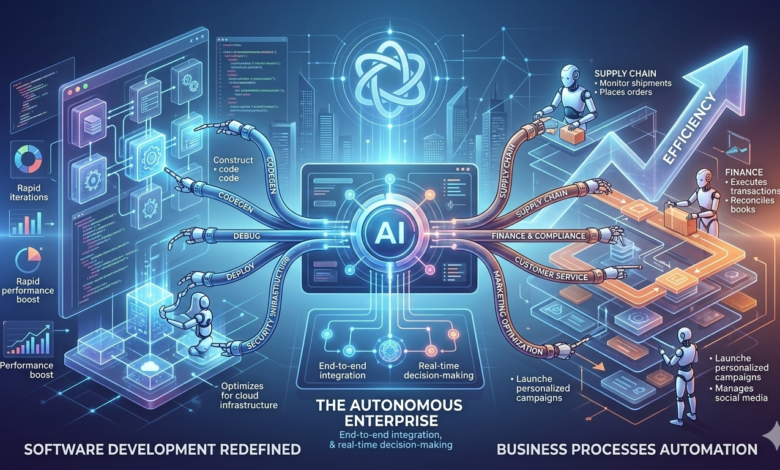
The era of AI experimentation is over. For years, businesses cautiously explored artificial intelligence’s potential. Now, in 2026, a profound shift is underway. Enterprises are moving beyond prototypes to strategic, organization-wide implementations, demanding measurable returns on their AI investments. This transition marks a new age: the rise of the autonomous enterprise, driven by intelligent AI agents transforming software development and core business operations. These aren’t mere chatbots; they are proactive, goal-oriented systems capable of complex, multi-step workflows.
The AI-Powered Software Revolution Takes Hold
Artificial intelligence is no longer a peripheral tool; it has become central to enterprise strategy. In fact, worldwide AI spending is forecast to reach a staggering $2.52 trillion in 2026, marking a 44% year-over-year increase. This massive investment reflects AI’s growing influence. Specifically, the AI software market is projected to reach $386.08 billion in 2026, growing at a compound annual rate of 31.9%. This growth is largely fueled by the increasing adoption of enterprise AI solutions and advancements in machine learning algorithms.
The impact on software development is particularly striking. More than 80% of developers already use or plan to use AI coding assistants. These tools are automating routine tasks, improving data-driven decision-making, and significantly enhancing innovation. Notably, AI-authored code now constitutes 26.9% of all production code, a substantial increase from just 22% in the previous quarter. This indicates a rapid integration of AI into the core of software creation.
From Co-Pilot to Co-Creator: AI in Development Workflows
AI’s role in software development has evolved rapidly from simple co-pilots to sophisticated co-creators. Developers are leveraging AI-powered tools for faster coding cycles, improved developer experience, and enhanced testing capabilities. AI can generate code, detect and fix bugs, optimize performance, and even create documentation and tests. This significantly accelerates the development process. For instance, controlled experiments show developers can complete tasks up to 50% faster with AI-assisted coding.
However, this increased speed comes with its own set of challenges. Research indicates that while AI saves developers around four hours a week, overall productivity gains have plateaued at approximately 10%. Moreover, concerns persist regarding the inconsistent quality of AI-generated code and its limited understanding of complex logic. Studies also project a doubling of “code churn,” where a significant percentage of code is discarded shortly after being written, suggesting a need for more rigorous review processes for AI-generated output. Therefore, strategic adoption, balancing speed with safety and productivity with governance, remains crucial for companies.
Driving Efficiency and Innovation
AI tools are proving invaluable across the entire Software Development Life Cycle (SDLC). They streamline tasks from initial design to deployment, thereby enabling teams to focus on more strategic problem-solving. For example, AI-driven monitoring and alerting reduce downtime, while automated test generation boosts code coverage. This shift allows human developers to move beyond repetitive coding to higher-value activities.
Furthermore, AI facilitates knowledge sharing. Junior developers can learn coding patterns and best practices through AI-assisted suggestions, which helps onboard new talent more quickly. Consequently, the industry observes a clear trend towards augmented human capabilities, not replacement. A skilled engineer utilizing AI will consistently outperform AI alone.
The Rise of Autonomous Agents and Intelligent Automation
Beyond assisting individual developers, AI is now powering autonomous agents that can perform complex business operations independently. Jensen Huang, CEO of NVIDIA, accurately predicted that 2025 would be the year of AI agents, and market numbers confirm this forecast. The global AI agents market reached $4.8 billion in 2024 and is projected to surge to $28.5 billion by 2030, exhibiting a compound annual growth rate of 34.2%. By 2028, experts anticipate at least 15% of work decisions will be handled autonomously by agentic AI, a significant leap from near zero in 2024.
These autonomous agents are distinctly different from traditional chatbots or automation scripts. They understand goals, plan action sequences, execute tasks across various systems, and learn from results. They are proactive rather than reactive, enabling business process automation at an unprecedented scale. PwC’s May 2025 AI Agent Survey reported that 79% of senior executives already use AI agents in their companies, with 66% seeing measurable productivity gains. Over half also noted cost savings (57%), faster decision-making (55%), and improved customer experience (54%).
Business and Investor Implications
The profound impact of autonomous agents on operational economics cannot be overstated. Organizations report 45-70% productivity gains and 25-40% cost reductions from proper implementations. Real-world deployments highlight this scale: a major U.S. retailer achieved $2 million in annual savings while reducing average customer service call times to 85 seconds. JPMorgan’s COIN system, for example, saves 360,000 hours annually by analyzing legal contracts.
Investors are increasingly selective, shifting focus from pure AI infrastructure to AI platform stocks and productivity beneficiaries. While consensus estimates for hyperscaler AI capital expenditure in 2026 are around $527 billion, the market increasingly rewards companies demonstrating a clear link between AI investment and revenue growth. This indicates a maturation of the AI investment landscape, favoring practical, value-generating solutions.
Navigating the AI Frontier: Opportunities and Risks
The deployment of AI agents and advanced AI solutions presents both immense opportunities and significant risks for enterprises.
Opportunities
- Rapid Innovation: AI enhances innovation by automating repetitive tasks, thereby freeing human resources for strategic activities. This accelerates the development of new functionalities and services.
- Cost Reduction & Efficiency: Automation through AI agents minimizes errors and handles tasks faster than humans, leading to substantial cost savings and operational efficiencies. Organizations report up to 80% cost reduction in unstructured document processing.
- Hyper-Personalization: AI and machine learning drive hyper-personalization, tailoring product recommendations, messaging, and services to individual users in real time. The global hyper-personalization market is projected to grow from $25.7 billion in 2025 to nearly $49.6 billion by 2029, driven by demand for individualized experiences.
- Enhanced Decision-Making: AI agents analyze vast datasets, uncovering insights human analysts might miss. This supports faster, data-driven decisions.
- Scalability: AI agents operate 24/7, offering consistent performance and enabling organizations to scale operations effectively.
Risks and Challenges
Despite the clear benefits, enterprise AI adoption faces considerable hurdles.
- Data Quality and Governance: A fundamental challenge involves the need for reliable, structured, and up-to-date data. Many companies struggle with information scattered across disconnected systems, hindering AI model performance. The absence of robust data governance can compromise algorithm accuracy and erode trust in AI-driven decisions.
- Integration with Legacy Systems: Integrating AI into existing technology stacks poses a major challenge. Legacy systems often lack compatibility, creating technical and operational friction. Enterprise AI solutions that integrate seamlessly with existing tech stacks see three times higher adoption rates.
- Talent Gaps and Skills: A significant barrier is the shortage of specialized AI talent. Companies struggle to adapt to new work models and upskill employees to work alongside AI.
- Ethical Considerations and Bias: AI models, especially those trained on historical data, can perpetuate existing biases, leading to discriminatory or unfair outcomes. Ensuring fairness, transparency, and accountability in AI systems is paramount.
- Privacy and Security: AI systems involve processing massive amounts of data, raising significant privacy and security concerns. Data leakage, prompt injection attacks, and the potential for employees to access sensitive information through AI tools are real threats. AI-related privacy and security incidents jumped 56.4% in 2024 alone, with 233 reported cases. Compliance with regulations like GDPR is critical.
- Cost and ROI: Implementing AI requires substantial upfront investment. While benefits are clear, demonstrating a measurable return on investment remains a challenge for many, with 95% of organizations reporting zero ROI from enterprise Generative AI investment despite significant spending. Only 18% of GenAI use cases implemented in 2024 yielded measurable ROI.
- Hallucinations and Accuracy: Generative AI models can fabricate information, citations, and data points, which can mislead decision-makers and create reputational risks.
- Vendor Lock-in and Dependency: The fragmented AI vendor landscape raises concerns about vendor lock-in and dependency risks, as switching providers can be technically and financially prohibitive.
Data-Driven Insights: Quantifying the AI Impact
The numbers clearly illustrate AI’s accelerating trajectory. The global enterprise AI market, valued at $98 billion in 2025, is projected to reach $116.6 billion in 2026 and surge to $558 billion by 2035, growing at a CAGR of 19% from 2026 to 2035. Similarly, the global AI in ERP market, valued at $5.82 billion in 2025, is expected to grow to $7.33 billion in 2026 and then dramatically to $58.7 billion by 2035, expanding at a CAGR of 26%. This growth is driven by the increasing demand for intelligent automation and real-time analytics.
Cloud-based solutions dominate the AI in ERP market, holding an 82% share in 2025. Machine learning holds the largest technology share at 63% in 2025. Large enterprises currently account for 59% of the market in 2025, although small and medium enterprises (SMEs) are expected to exhibit the fastest CAGR in the forecast period. Finance leaders also plan to increase their finance function AI investments by 10% or more in 2026.
In terms of market investment, total worldwide AI spending could reach nearly $1.5 trillion in 2025, over $2 trillion in 2026, and $3.3 trillion by 2029. Moreover, 71% of organizations plan to increase spending on AI technologies in 2026. This strong commitment reflects AI’s undeniable potential for innovation and operational efficiency. However, a significant percentage of AI leaders (74%) report productivity gains from AI, but only 11% say their organization has seen measurable financial value in 2025. This gap between productivity and tangible financial ROI is forcing enterprises to refine their AI strategies.
The Unfolding Future: AI as the Enterprise OS
Looking ahead, AI is set to become the veritable operating system of the enterprise. The experimental phase has ended, and organizations are actively moving from pilots to large-scale production deployments. We anticipate deeper integration of AI agents as built-in features within most enterprise platforms, rather than mere add-ons. They will seamlessly integrate into logistics, supply chain management, and customer intelligence systems.
More autonomy will characterize future AI agents, enabling them to make more decisions without direct human intervention. Cross-agent collaboration, where different AI agents communicate and work together to complete complex tasks, will become commonplace. Furthermore, there will be increased emphasis on ethical and transparent AI, with a focus on explainable AI, ethical AI toolkits, and stricter regulations.
Hyper-personalization, powered by generative AI, will evolve to tailor not only recommendations but also creative elements like personalized media, messaging, and adaptive interfaces. Predictive engagement systems will anticipate customer needs, proactively delivering relevant offers and messages. Ultimately, the future enterprise will thrive on adaptive, intelligent systems that foster highly effective human-AI collaboration.
Conclusion
Artificial intelligence is undergoing a profound transformation, moving from nascent exploration to decisive enterprise integration. AI-powered development tools are dramatically enhancing software creation, while autonomous AI agents are redefining business operations and unlocking unprecedented efficiencies. This shift, however, necessitates a careful navigation of challenges like data quality, ethical considerations, and the critical demand for measurable ROI.
The coming years will see AI permeate every facet of the enterprise, functioning as a strategic core rather than a supplementary tool. Organizations that invest wisely in robust AI platforms, prioritize data governance, and cultivate an AI-literate workforce will secure significant competitive advantages. Ultimately, the autonomous enterprise, powered by intelligent AI, is not a distant vision but our rapidly unfolding reality, promising a future of unprecedented innovation and operational agility.